
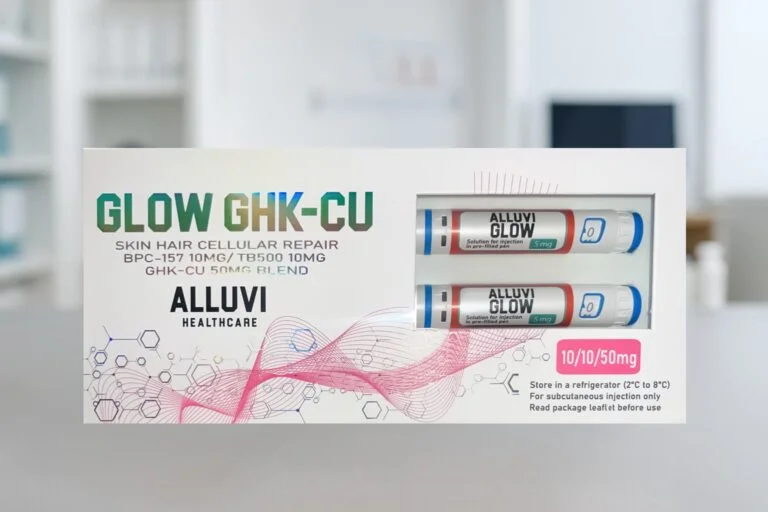
Glow 70mg (R&D Only)
Introduction to Glow 70mg GHK-CU Copper Peptide
Glow 70mg GHK-CU represents a premium research-grade copper peptide complex designed for qualified laboratories conducting investigations into skin regeneration mechanisms, collagen synthesis pathways, and gene expression modulation. As one of the most extensively studied peptides in regenerative medicine research, GHK-Cu (glycyl-L-histidyl-L-lysine copper complex) offers researchers a powerful tool for examining tissue remodeling, antioxidant defense systems, and copper-mediated biological processes.
Manufactured under pharmaceutical-grade conditions, our Glow 70mg GHK-CU formulation provides researchers with high-purity material suitable for in vitro studies, gene expression analysis, and mechanistic investigations—exclusively for laboratory research purposes.
Why “Glow” GHK-Cu?
The “Glow” designation reflects GHK-Cu’s extensive research applications in dermatological and cosmetic science:
- Decades of published research on skin regeneration mechanisms
- Wide use in cosmetic formulations (INCI: Copper Tripeptide-1)
- Distinctive natural blue color of the copper complex
- Focus on extracellular matrix remodeling and collagen synthesis
Product Specifications: Glow 70mg GHK-CU
| Specification | Details |
|---|---|
| Product Name | Glow GHK-Cu (Copper Tripeptide-1) |
| Chemical Name | Glycyl-L-Histidyl-L-Lysine Copper Complex |
| Peptide Sequence | Gly-His-Lys (Cu²⁺) |
| Molecular Formula | C₁₄H₂₃CuN₆O₄ |
| Molecular Weight | 401.91 g/mol |
| CAS Number | 89030-95-5 |
| PubChem CID | 73587 |
| Strength per Vial | 70mg GHK-Cu complex |
| Grade Classification | Research Use Only (RUO) / Cosmetic Research Grade |
| Form | Lyophilized peptide powder (distinctive blue color) |
| Purity Level | ≥98% (HPLC verified, COA provided per batch) |
| Intended Application | In vitro research & cosmetic formulation development only – NOT for human injection or therapeutic use |
| Storage Conditions | -20°C to -80°C (lyophilized form); 2-8°C after reconstitution |
| Appearance (Solution) | Blue-colored solution (characteristic of Cu²⁺ complex) |
Each batch undergoes comprehensive quality control including HPLC purity verification, mass spectrometry for molecular weight confirmation, copper content analysis, and sterility testing to ensure researchers receive pharmaceutical-grade materials for reliable experimental outcomes.
Understanding GHK-Cu: The Copper Peptide Complex
Discovery & Natural Occurrence
GHK-Cu was first isolated in 1973 by Dr. Loren Pickart from human plasma albumin. This naturally occurring tripeptide demonstrates a remarkably high affinity for copper(II) ions, forming a stable copper complex with a distinctive blue color and exceptional biological activity.
Natural Occurrence in Human Biology
- Plasma Concentration: ~200 ng/mL (10⁻⁷ M) at age 20
- Age-Related Decline: Drops to ~80 ng/mL by age 60
- Distribution: Found in plasma, saliva, and urine
- Endogenous Release: Released from tissue proteins (especially collagen and SPARC glycoprotein) following injury
- Biological Role: Functions as an emergency response molecule and copper carrier
The GHK Sequence in Nature
The GHK tripeptide sequence is naturally present in the alpha-2(I) chain of Type I collagen and can be liberated by proteases at wound sites. The glycoprotein SPARC (Secreted Protein Acidic and Rich in Cysteine), always present at tissue remodeling sites, releases GHK-Cu upon proteolytic breakdown.
Mechanism of Action: Multi-Pathway Modulation
GHK-Cu operates through several interconnected mechanisms, making it one of the most pleiotropic peptides in regenerative research:
1. Gene Expression Modulation
Landmark research using the Broad Institute’s Connectivity Map revealed that GHK influences gene expression on a massive scale:
- Scope: Modulates expression of 31.2% of human genes (at ≥50% change threshold)
- Direction: Upregulates 59% of affected genes, suppresses 41%
- Pathways: Affects genes involved in tissue repair, inflammation, oxidative stress, cell proliferation, and apoptosis
- Gene Categories: Resets gene expression patterns to resemble younger, healthier tissue
2. Copper Chelation & Delivery
The copper complex structure provides unique biological advantages:
- Stability Constant: Log₁₀ = 16.44 (extremely high affinity for Cu²⁺)
- Coordination Structure: Cu²⁺ coordinated by histidine imidazole nitrogen, glycine alpha-amino nitrogen, and deprotonated amide nitrogen
- Copper Delivery: Modulates cellular copper uptake and bioavailability
- Enzymatic Cofactor: Copper serves as cofactor for lysyl oxidase and lysyl hydroxylase (essential for collagen cross-linking)
3. Extracellular Matrix (ECM) Remodeling
- Collagen Synthesis: Increases Type I and Type III collagen production (up to 70% increase in laboratory studies)
- Elastin Production: Stimulates elastin synthesis for tissue flexibility
- Glycosaminoglycan (GAG) Synthesis: Enhances production of structural polysaccharides
- Decorin Stimulation: Increases decorin (proteoglycan regulating collagen synthesis and organization)
- Matrix Metalloproteinases (MMPs): Stimulates MMP-1 and MMP-2 for controlled matrix remodeling
- TIMPs: Increases Tissue Inhibitor of Metalloproteinases (TIMP-1) for balanced turnover
4. Growth Factor Stimulation
GHK-Cu promotes release of multiple growth factors critical for tissue regeneration:
- VEGF (Vascular Endothelial Growth Factor): Promotes angiogenesis and blood vessel formation
- BDNF (Brain-Derived Neurotrophic Factor): Supports neuronal survival and regeneration
- BMP-2 (Bone Morphogenetic Protein 2): Involved in bone and cartilage formation
- TGF-β Modulation: Influences transforming growth factor beta signaling
5. Antioxidant & Anti-Inflammatory Actions
- Free Radical Scavenging: Quenches reactive oxygen species (ROS) and lipid peroxidation products
- 4-HNE Neutralization: Quenches 4-hydroxy-trans-2-nonenal (toxic lipid peroxidation product)
- Acrolein Quenching: Neutralizes acrolein (age-related toxic aldehyde)
- Iron Regulation: Inhibits ferritin iron release in damaged tissues
- Cytokine Modulation: Reduces pro-inflammatory cytokines (IL-6, TNF-α)
6. Cellular Processes Enhanced
- Fibroblast Proliferation: Increases fibroblast activity and migration
- Keratinocyte Migration: Enhances re-epithelialization
- Endothelial Cell Growth: Supports blood vessel formation
- Immune Cell Recruitment: Attracts immune cells to injury sites
- Stem Cell Function: May help restore replicative vitality to aged cells
Research Context: In Vitro vs. In Vivo vs. Clinical
Important distinctions for researchers:
- In Vitro Data: Extensive cell culture studies (fibroblasts, keratinocytes, endothelial cells)
- Animal Models: Demonstrated wound healing, tissue repair in rats, rabbits, mice
- Human Topical Studies: Multiple small clinical trials showing cosmetic benefits (skin thickness, wrinkles, firmness)
- Injectable Data: Very limited human data; FDA has raised safety concerns for injectable forms
- Long-Term Safety: Decades of cosmetic use without major issues; injectable safety profile less established
buy glow GHK-Cu pen UK
glow GHK-Cu injection pen for sale UK
order glow GHK-Cu pen online UK
glow GHK-Cu peptide pen UK price
Related products
Alluvi Healthcare

Alluvi Healthcare
Alluvi Healthcare
Peptide
Alluvi Healthcare
Alluvi Healthcare
Alluvi Healthcare
Alluvi Healthcare